Showing posts with label medicine. Show all posts

Wednesday, January 13, 2010

Oral Contraceptive Pill


For women who are involved in family planning, some of them must be very familiar with oral contraceptive pill. one of the usage of oral contraceptive pill is it control the pregnancy of women. but how? let us continue reading this article below...

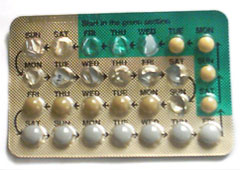
The two hormones in the combined oral contraceptive pill, oestrogen and progestogen work on several levels to prevent pregnancy. Primarily, the Pill works by stopping ovulation (the release of an egg from the ovary). If an egg is not released then of course conception cannot take place. As a back-up, the Pill also makes the mucus released by the cervix thicker so the sperm cannot get through and thins the lining of the uterus so a fertilised egg has difficulty implanting.

The Pill and 'periods'
When a woman takes the Pill her normal menstrual cycle is interrupted. In effect, the Pill tricks the body into believing it is pregnant. When the Pill was being developed, however, it was felt that women would find the lack of a normal menstrual cycle disconcerting. Many women, for example, rely on their regular menstrual period for reassurance of not being pregnant. Consequently, it was decided to have the Pill consist of 21 days of active pills (pills containing the hormones), followed by a pill-free interval of seven days (either no pills or sugar pills). The rapid decline in the artificial hormones which occurs in the pill-free interval results in a 'withdrawal bleed', which somewhat resembles a menstrual period and is often still referred to as a 'period' for simplicity. It is important, however, for women to understand that when they take the Pill the bleeding which occurs during the pill free interval is not a menstrual period.

Similarly, women should be aware the current packaging of the Pill (21 active pills, seven day pill free interval) was developed primarily for acceptability reasons and not because of any physiological reason. Indeed, contraception expert John Guillebaud explains "When you think about it we have here a bizarre contraceptive: one that we providers actually instruct the users not to use - for 25% of the time" (4). As Guillebaud suggests, the pill free interval is the 'Achilles heel' of the Pill's efficacy as it can contribute to pill failure. To stop ovulation from occurring a woman needs to take seven consecutive active pills. In addition, if more than seven days are missed a woman risks ovulation and, if unprotected intercourse occurs, pregnancy. The lengthening of the pill free interval is one of the most common causes of pill failure and is often associated with a woman starting her new Pill packet late. It is very easy to start a pill packet late with women either simply forgetting or not having their new packet with them.

Similarly, if some of the active pills near the end of the previous packet or active pills near the start of the new packet are either missed or not absorbed properly (due to vomiting, diarrhoea, use of antibiotics) this can also mean that there has not been enough pills taken overall to prevent ovulation. Women who miss pills towards the end of their packet often mistakenly believe it does not matter because they are having their 'period' soon. They do not realise that missing pills near the pill free interval may mean they have not taken enough pills to prevent ovulation in the next month. The most dangerous time to miss a pill is at the end or beginning of a packet (because it lengthens the pill free interval beyond seven days).

So why have a pill free interval?
As discussed above, the pill free interval was devised in the early days of the Pill because it was felt that women would find having a 'period' more acceptable. Additionally, all the data on the safety of the Pill was conducted using women who were having a pill free interval (5). If women did not have a pill free interval they would actually be taking more pills a year and, therefore, would be exposed to more of the hormones. For a range of reasons, however, women may choose to tricycle their pill (taking three packets together without a pill free interval), thus reducing the number of withdrawal bleeds a year from 12 to four.

Who could benefit from tricycling?
Women who suffer from headaches or migraines triggered by the sudden drop in hormones during the pill free week and women who experience heavy bleeding may benefit from tricycling. Tricycling is also often recommended for women with endometriosis as it reduces the number of painful withdrawal bleeds and the opportunities for retrograde menstruation (where blood travels in the wrong direction up the fallopian tubes and into the pelvis), thought to be one of the causes of endometriosis. For women who are debilitated by symptoms during the pill free interval, reducing the number of withdrawal bleeds can be extremely beneficial. Tricycling or bicycling (taking two packets together with no pill free interval) can also be useful for women who wish to avoid the withdrawal bleed for special occasions like travel or a honeymoon.

It is important to note that for women taking a fixed dose Pill (all the active pills in the packet are the same) tricycling simply involves taking several packets together without the pill free interval. However, when women are on a phasic Pill (where there are two or three different types of active pills), simply running the packets together can result in break through bleeding (although it will not reduce the efficacy of the contraception). Women taking a phasic pill, therefore, should ask their health care provider about how to tricycle.

if u are interested in learning more about oral contraceptive pill, please visit this website http://www.womhealth.org.au/healthjourney/pill_myths_misconceptions.htm

~ani arina~

Sunday, January 10, 2010

Effects of Epidural Anesthesia on Labor Progress


Labor pain is known and defined as one of the most severe varieties of pain. As a result, an appropriate pain management plan is important both for a successful delivery and to decrease pain as much as possible (Poole, 2003). A variety of anesthesia methods for delivery are used in different regions of the world. Epidural anesthesia is the most frequently used method of pain control. It is reliable and is the preferred method of anesthesia for over 50% of hospitalized women in developed countries (Balcioglu, 2004; Camann, 2005; Essam & Arulkumaran, 2005 Lieberman 2004, Robert and Gaiser 2005). Today, the use of epidural analgesia is rapidly on the rise globally. Reasons for this increase include the decreased risk of morbidity, developments in epidural techniques, and women's pain-free delivery experiences (Robert and Gaiser 2005, Vincent and Chestnuta 1998).

Although delivery is a normal physiologic process, it causes a certain level of pain in women. Today, the most frequently preferred and the most used method is epidural anesthesia. The objective of the present study was to review the reasons, effects, and risks associated with epidural analgesia for pain relief. The study was conducted at Akdeniz University Hospital, Antalya, Turkey, between October 2004 and July 2005. Epidural analgesia was administered to 51 pregnant women in the experimental group, and 51 pregnant women in the control group did not receive analgesia. Data were collected by questionnaire and observation forms. Epidural anesthesia was chosen by 76.5% of the participants because they wanted to experience a pain-free childbirth, 66.7% because they were afraid of the process of delivery, 25.5% because they had had a previous bad labor experience, 35.3% because they had people around them with positive experiences, 29.4% because they wanted to have a normal delivery, and 31.4% because they wanted first to see their baby. The overwhelming majority of the participants (94.1%) experienced nervousness before the administration of epidural analgesia. It was determined that epidural analgesia extended the time of labor and increased oxygen and oxytocin requirement but did not increase the risk for interventional delivery and cesarean. To give better obstetric care and control of labor pain, it is of clinical importance to know obstetric anesthesia and analgesics.

Epidural labor analgesia can have positive effects, such as a decrease in mothers' stress as a result of labor pain relief, balancing of respiratory rate and amplitude, lack of disturbance in maternal and fetal acid base balance and uteroplacental circulation, and decrease in blood pressure in preeclampsia. In addition to these physiologic benefits, epidural labor analgesia also provides patients with psychologic comfort and alleviation of excessive pain and ensures that they leave the hospital more satisfied (Bofill et al., 1997). In contrast, Mayberry et al. (2002) found that epidural anesthesia causes maternal exhaustion, which in turn causes the pelvic floor to be damaged and an increase in the incidence of cesarean. Other side effects of epidural analgesia may be cited, such as maternal hypotension, itching, shivering, fever, urinary retention, and dural puncture (Leighton and Halpern 2002a, Lieberman 2004, Mayberry et al 2002).

However, there are some studies showing the contrary, it is reported that epidural analgesia procedure does not increase the percentage of cesarean procedures (Bofill et al 1997, Clark et al 1998, Owen et al 1998, Robert and Gaiser 2005, Sharma et al 1997). According to Nystedt et al.'s (2004) review, with unclear evidence it was difficult to confirm that adverse effects in terms of dystocia and increased frequency of cesarean section were associated with the use of epidural analgesia. In the present study, no cesarean procedures were conducted in either the epidural analgesia group or the control group . This finding is consistent with other studies showing that epidural analgesia does not increase the incidence of Cesarean procedures (Clark et al 1998, Segal et al 1999; Sahin & Owen, 2002). It was determined that women receiving epidural anesthesia required more supplemental oxygen than those who did not receive epidural anesthesia. This may be due to the fact that women become more tired with the increased duration of stages one and two of labor. Essam and Arulkumaran (2005) determined that, although there are benefits to using high-dose oxytocin in both multiparas and nulliparas in advanced labor and for optimal contractions, if the labor process is slow it is necessary to give oxytocin in the first 6-8 hours. In the present study, oxytocin was used regardless of whether women were nulliparous or multiparous. Bodner et al. (2003) determined that there was a difference in newborns' APGAR scores in cases where epidural analgesia was and was not used. The most common side effects related to epidural anesthesia were sedation and nausea. These were followed by shivering, vomiting, itching, hypotension, fetal bradycardia, and ringing in the ears . These findings are similar to those seen in other studies (Leighton and Halpern 2002b, Vincent and Chestnuta 1998). Whereas 68.6% of women who received epidural anesthesia were happy in the fourth stage, this ratio was only 31.4% for women who had not received epidural anesthesia. This shows that women did not feel pain during labor, that labor concluded successfully, that women were aware of all the events during labor, and that they felt comfortable. (El-Hamamy & Arulkumaran, 2005)

The present findings demonstrate that antenatal care and education should be focused on helping women work through their fears and increase their understanding of the process of labor and childbirth. Nurses and midwives who work in primary care settings and in labor and delivery wards need to be given education by experts concerning effects, side effects, potential emergency complications, and the emergency interventions for these complications in pregnant women who are given epidural analgesia.

This article was quoted from
http://www.medscape.com/viewarticle/573875_5.

By Izzaty....

Thursday, December 31, 2009

Suffering From Menstrual Pain? Want To Know More About It?

Well.. first of all, i would like to welcome all of u who are willing to drop by to our blog and since this is the first post for this blog, i would like to begin with a topic that many of us women out there suffer especially during your menstrual cycle.. some of us have experienced extreme pain in the stomach, mood swing, and even nausea and vomiting.. all of this symptoms are called premenstrual syndromes or PMS..

however, you don't have to worry anymore.. nowadays, there are many pills that you can take to relief the pain such as aspirin and acetaminophen.. these are among the drugs that are categorized under non-steroidal anti-inflammatory drugs (NSAIDS).. nevertheless, you have to follow the right doses and insructions when taking these drugs..

besides, if you don't want to take any medication, changing your lifestyles might also help in reducing the pain.. reduce salts and refine sugar intake and also caffeine since it can cause irritability.. and most importantly, don't forget to exercise..

so, i guess this is all for now.. if you want to know more about PMS and the treatment, you can visit this website..

http://www.medicinenet.com/menstrual_cramps_and_pms_medication_guide/article.htm

written by: anie